Integrated Framework of Five Models: Alpha Demonstration and Future Development Towards Interaction and Graph Analysis
The set of five models forms a unified, experimental analytical environment that enables exploration of the structure, dynamics, and policy implications of the Latvian and Baltic economies at multiple levels. These tools were developed through an iterative, experimental process, combining human analytical thinking with generative AI capabilities in a close and intensive collaboration, creating a shared, dynamic development environment. All models are currently in alpha stage, designed for demonstration purposes to test the concept, usability, and potential research value.
The first model analyses value chains across Latvian cities and sectors, showing spatial concentration and its link to productivity. The second model simulates the interaction between productivity and investment, emphasising capital accumulation and innovation. The third model expands the perspective to the Baltic region, modelling flows of goods and services, shock propagation, and interdependence. The fourth model combines competitiveness and resilience dimensions, based on Porter and Holling, showing how innovation, clusters, and economic diversity shape growth and shock absorption. The fifth model allows users to build growth scenarios by selecting policy packages and observing their effects on GDP and welfare over time.
Together, these models form a multi‑layered system covering micro‑, meso‑, and macroeconomic processes. They allow analysis of spatial structure, economic dynamics, and policy outcomes. The models are mutually reinforcing: value chain structure affects productivity; productivity shapes competitiveness; competitiveness and resilience determine shock response; and policy choices shape development trajectories.
The models are interactive simulations that help users intuitively understand complex economic relationships. They are conceptual prototypes intended to test whether such an approach can be further developed. Importantly, these models are not designed for precise forecasting but for structured thinking about interactions between economic factors.
The interaction aspect is central — future development will incorporate graph‑analysis elements to formally represent and analyse links between sectors, regions, and policy instruments. This approach would identify high‑impact nodes, critical connections, vulnerabilities, and simulate shock propagation. Such development would make the models not only visually informative but analytically powerful, especially for meso‑level research.
The alpha version serves as a foundation for building more complex systems based on interaction modelling and graph analysis. Overall, the five tools form a transparent, user‑friendly platform that helps understand economic complexity and supports better‑informed decisions.
➜ Open Tool No.1:
Open Tool No.1 “Value Chains in Latvia”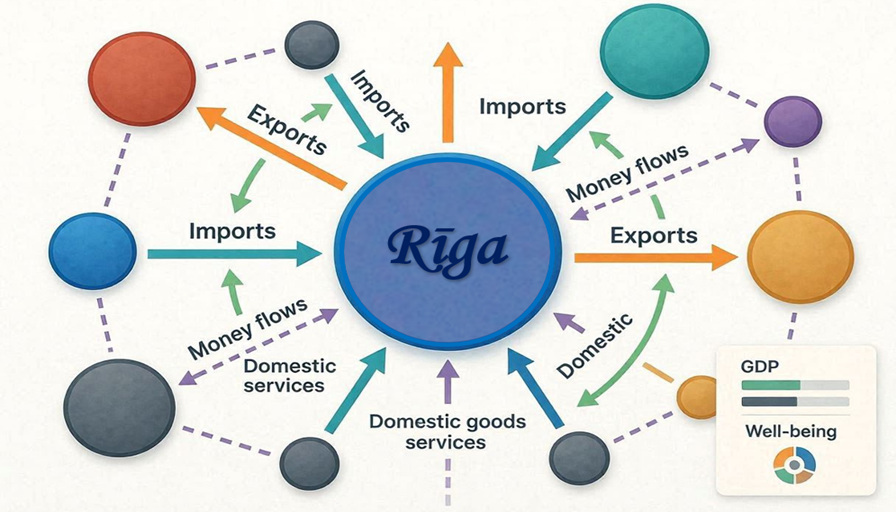
What Is Competitiveness?
Competitiveness is the ability to create value that is in demand both domestically and internationally. It includes the capacity to adapt to change, innovate, and use resources efficiently. Competitiveness is not only an economic indicator — it is also a foundation for societal development and well‑being. It determines how successfully companies can grow and how attractive a country is to investors. A competitive economy can ensure a higher standard of living and more opportunities for its people. It is closely linked to education quality, innovation capacity, and the effectiveness of public administration. Competitiveness is not static — it constantly evolves and requires continuous adaptation. Countries that invest in human capital and technology become stronger in the long run. Competitiveness also reflects the mindset and values of society. Therefore, it is essential for everyone to understand its importance and contribute to its development.

Main Elements of Competitiveness
Competitiveness is shaped by several interconnected factors that together form the foundation of national development. Education provides the knowledge and skills needed for a modern economy. Innovation enables the creation of new products and services that can compete globally. Infrastructure ensures an efficient business environment and connectivity. The quality of public administration affects business trust and investment attractiveness. The business environment determines how easy it is to start and grow a company. Public engagement helps create sustainable solutions and strengthens democracy. All these elements form a system that determines a country’s ability to compete. If one element is weak, it affects the entire system. Therefore, strengthening competitiveness requires a complex, long‑term approach.

Economic Decision Simulator – “decision_tool”
This is an interactive economic scenario tool designed as a conceptual demonstrator and a thinking‑training instrument. It allows the user to model Latvia’s development trajectories step by step by making 16 sequential policy decisions and observing their impact on macroeconomics, competitiveness, welfare, and structural change.
The tool was created through AI–human collaboration using an iterative approach to build an intuitive, easy‑to‑use, and conceptually clear simulation environment. It is not intended for precise forecasting — its purpose is analytical thinking, scenario comparison, and understanding policy trade‑offs.
What Does the Tool Do Economically?
The simulator is based on 27 indicators covering macroeconomics, productivity, exports, human capital, institutions, demography, and sustainability. Each decision affects multiple indicators simultaneously using weighted impact matrices and a small randomisation component that reflects economic uncertainty.
The tool also calculates two target indices:
- External Competitiveness Index (ECI) – based on export capacity, productivity, high‑tech share, and investment.
- Internal Competition Intensity (ICI) – based on business environment, bureaucracy burden, and digitalisation.
Mathematically, the tool uses:
- linear combinations with weighted coefficients,
- cause–effect structures between indicators,
- a small randomness component in each decision’s effect,
- dynamic index recalculation after each quarter.
This approach helps users understand how policy choices create trade‑offs between growth, competitiveness, social protection, and fiscal stability.
How Does the Simulation Work?
- Step 1: The user sees Latvia’s initial indicators.
- Each next step: one of 15 policy options is selected.
- Each step = 1 quarter with updated indicators.
- After step 16: a final summary is shown (Start → Finish).
- LV/EN mode: full bilingual interface.
The final summary includes:
- changes in key indicators,
- ECI and ICI dynamics,
- overall competitiveness and welfare index,
- a clear Start vs Finish comparison.
➜ Open the economic decision simulator:
Open “decision_tool”
Scenario Toolset – Beta Version
This is a beta version of an interactive scenario toolset developed for demonstration and concept‑testing purposes. All 14 models were created with AI assistance based on user requests and iterative collaboration. The tool is not intended for precise forecasting — its purpose is learning, discussion, and structured thinking about Latvia’s development options.
The models allow experimentation with various economic parameters to understand how policy choices affect GDP, competitiveness, welfare, exports, demography, and the environment.
What Do the Models Do Economically?
Each model uses simplified linear combinations, weighted coefficients, and cause–effect structures to show how parameter changes affect key macroeconomic indicators.
Mathematically, the models work as follows:
- Parameters (taxes, investment, productivity, exports, demography, etc.) are converted into numeric values.
- Each parameter has a coefficient determining its direction and strength of impact.
- The result is calculated as a weighted sum, similar to econometric models.
- Some models include opposing effects (e.g., higher taxes reduce GDP but increase social welfare).
- The graph shows a 5‑year trajectory using a linear function.
The goal is not to predict the future but to help users see system logic and understand how different choices change outcome structures.
➜ Start with the first model:
Open Model 1 (GDP Scenarios)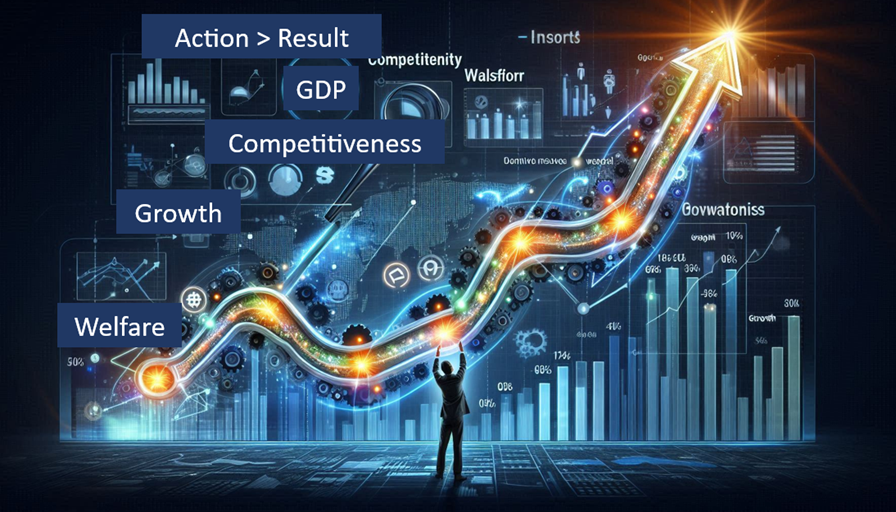
Reducing Bureaucracy and Measuring It
Reducing bureaucracy is one of the key prerequisites for improving the business environment and national competitiveness. Excessive administrative burden slows decision‑making, creates uncertainty, and reduces companies’ ability to respond quickly to market changes. Effective public administration means simple processes, clear rules, and fast service availability for both businesses and citizens. Reducing bureaucracy is not just about cutting documents — it is a mindset shift where public administration becomes a partner rather than an obstacle.
To assess progress, it is important to use clear and comparable metrics. These help identify areas where administrative burden is highest and where reforms are needed. Key metric categories include process duration, costs, number of required documents, and availability of digital services. These indicators allow objective evaluation of how efficiently public administration works and how easy it is for businesses and citizens to receive services. Reducing bureaucracy is a long‑term process requiring cooperation between institutions, entrepreneurs, and society. Latvia has the opportunity to become a country where bureaucracy does not hinder development but supports it.
Possible metrics for measuring bureaucracy:
- Process duration — minutes, hours, or days required to receive a service.
- Number of required documents — how many separate documents must be submitted.
- Share of digital services — % of services that can be completed online.
- Share of repeated submissions — how often the same data must be submitted to multiple institutions.
- Administrative burden costs — time and money spent on bureaucratic procedures.
- Customer satisfaction indicators — ratings by citizens and businesses.
- Reduction in process steps — how many steps or requirements were eliminated after reforms.

The Importance of Exports
Exports are one of the main drivers of a national economy, enabling companies to sell goods and services in foreign markets, increase income, and strengthen overall welfare. Countries with strong export sectors typically achieve higher productivity, greater innovation, and more stable economic growth. Exporting companies are often more competitive because they operate in international environments requiring higher quality, efficiency, and adaptability. These companies also provide significant employment, often with higher wages and better professional development opportunities. Export development stimulates investment, innovation, and adoption of new technologies, strengthening the entire economy.
A positive trade balance — when exports exceed imports — is important because it means the country earns more than it spends in foreign trade. This helps accumulate capital, stabilise the financial system, and reduce external debt. However, imports are also essential, providing access to raw materials, technologies, and goods not available domestically. Thus, foreign trade — both imports and exports — is crucial for economic development. It ensures resource flows, competition, innovation, and opportunities for companies to grow.
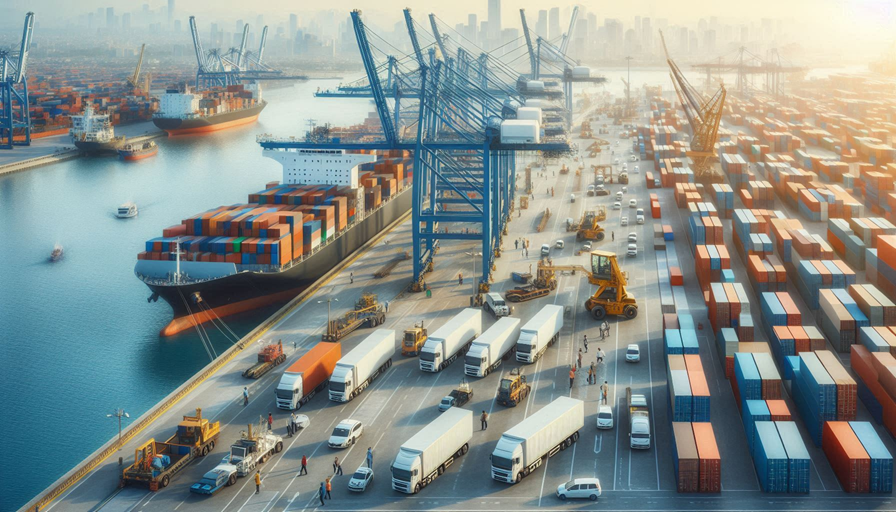
Export Promotion Measures and Their Importance
Export development is a key prerequisite for economic growth, as it provides income from foreign markets, strengthens competitiveness, and creates jobs. To export successfully, companies need a healthy macroeconomic environment — stable prices, predictable tax policy, efficient public administration, and access to capital. State support is especially important because it helps companies overcome initial barriers related to entering new markets, certification, logistics, and international marketing. Export promotion measures include financial instruments, consulting, and international cooperation that help companies integrate into global value chains.
The state’s role in export promotion is multifaceted. It includes support for innovation, export credit guarantees, market research programmes, participation in international exhibitions, and cooperation with foreign partners. At the same time, it is important to ensure a stable and business‑friendly environment — clear rules, efficient bureaucracy, and quality infrastructure. Export growth is also supported by investment in human capital, digital solutions, and modern production technologies.
Possible metrics for evaluating exports:
- Exports per capita — export intensity and comparability across countries.
- Imports per capita — openness and resource availability.
- Trade balance — difference between exports and imports.
- Market share in foreign markets.
- Share of high‑value‑added products.
- Share of services in exports — IT, finance, transport, etc.
- Export growth rates.
- Sectoral composition of exports.
- Impact of subsidies and taxes on exports.
The Role of Entrepreneurs
Entrepreneurs are the driving force of the economy, creating jobs and innovation. They take risks to develop new products and services. Their experience provides valuable insight into real market problems. Their perspective helps identify obstacles that hinder growth. Entrepreneurs are often the first to feel changes in the economy and technology. Their adaptability determines the country’s overall dynamism. A supportive business environment is essential for entrepreneurs to grow. If the environment is difficult, motivation and opportunities decline. Therefore, it is important to listen to entrepreneurs and consider their needs. Their involvement in policymaking is crucial for strengthening competitiveness.

The Importance of Public Opinion
Public opinion is essential because it reflects people’s everyday experiences. Citizens know best which services and solutions they lack. Their involvement helps shape policies that meet real needs. Public participation strengthens democracy and trust in institutions. People who feel heard are more motivated to contribute to national development. Diverse opinions help create balanced and sustainable solutions. Public involvement is especially important in long‑term policy planning. It helps identify problems that might otherwise go unnoticed. Citizens’ experience is a valuable resource that should not be ignored.

Why Is It Important to Share Your Experience?
Your experience helps understand how competitiveness manifests in everyday life. Responses help identify problems that hinder business and societal development. They provide insight into which solutions would be most effective. Policymakers use this data to design targeted measures. Your opinion can influence decisions affecting the entire country. Sharing experience strengthens democracy and public participation. It helps create an environment where people feel heard. Your responses are summarised and analysed professionally. They are delivered to those who make decisions about national development. Therefore, your involvement is extremely valuable and necessary.

Digital Transformation and Competitiveness
Digital transformation is one of the most important drivers of competitiveness in today’s world. It enables companies to work more efficiently and reach new markets. Technology helps automate processes and reduce costs. Digital solutions improve customer experience and service quality. Countries that invest in digital infrastructure become more attractive to investors. Digital skills are becoming essential in the labour market. Companies that fail to adapt lose competitiveness. Digital transformation requires both investment and a mindset shift. It is an opportunity to create new industries and innovations. Latvia has the potential to become a digital leader in the region.

The Importance of Education in Strengthening Competitiveness
Education is the foundation of a competitive society and economy. It provides the skills needed in the modern labour market. Quality education fosters innovation and creativity. Students who acquire digital skills are better prepared for the future. The education system must adapt to rapid global changes. Lifelong learning is becoming a necessity rather than a choice. Education quality affects national economic growth. Investment in education is a long‑term investment in the country’s future. A strong education system attracts talent and investors. Latvia has the opportunity to become a knowledge‑based economy in the Baltics.